How Long Does It Take to Learn Swimming?
No source can predict a reliable lesson count before the learner, programme and skill have been assessed. Define the goal, confirm one suitable block and compare progress at an agreed checkpoint.

First, define "learn to swim"
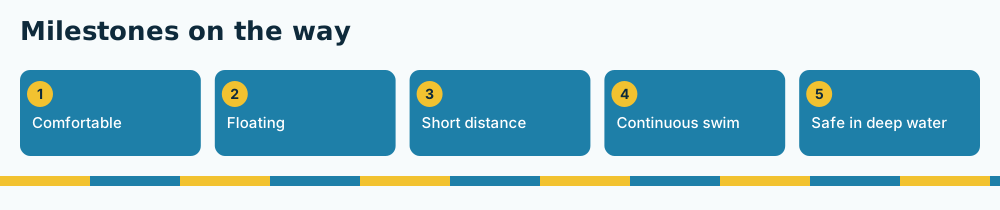
People mean different things by it. Use the following as example skill areas to define a goal, not as a universal sequence or proof of water safety:
- Comfortable in water: face in, breathing out, no panic.
- Floating and gliding independently.
- Swimming a short distance unaided with a basic stroke and breathing.
- Swimming continuously, for example several lengths, with controlled breathing.
- Deep-water skills: for example, treading water and changing direction under assessed conditions.
Each milestone can take a few lessons or many. Starting confidence, comfort in water, attendance, practice and the skill being assessed all affect the number needed.
Why no rough timeline is published
The cited sources do not establish a reliable lesson range by learner profile:
- Confident child, no fear: may move through early water-confidence skills differently from a child who is anxious or unfamiliar with the pool.
- Adult beginner without strong fear: may spend less time on water confidence than a nervous beginner, but no fixed timeline applies.
- Anyone with a strong fear of water: may need additional time on comfort, breathing and floating before working on strokes.
- Stroke refinement: define the exact technique point and how it will be reassessed.
Factors that can affect progress
- Frequency. Choose a schedule the learner can attend consistently and review it with the coach.
- Lesson format. 1-to-1 and group lessons offer different levels of coach attention; suitability depends on the learner. See private vs group.
- Practice between lessons. Ask whether any activity is recommended and how it must be supervised; lifeguard presence does not replace close supervision.
- An agreed goal and checkpoint. Ask what will be assessed and when, without assuming a package outcome.
Questions when progress differs from the plan
- Does fear or discomfort require a different confirmed water-confidence approach?
- Did attendance, practice conditions or a schedule change affect the agreed checkpoint?
- Should the skill order or lesson activity be reassessed for this learner?
- Has the coach, venue, format or programme changed, and how will prior progress be communicated?
Children vs adults
Age alone does not determine how quickly someone learns. Understanding an instruction, relaxing in the water, coordinating a movement and repeating it consistently may progress at different rates for each learner. For age-specific advice see the best age to learn swimming, and for course details the kids swimming course and adult swimming course.
Budgeting without a timeline forecast
Confirm the first block's price, duration, entry charges and written terms, then decide any next purchase from assessed progress. The lesson-count guide explains checkpoints, with current published fees on the swimming course fees page.
Sources
- ActiveSG Circle (Sport Singapore), SwimSafer. Each of the six SwimSafer stages involves approximately 12 hours of lesson time.
- CDC, Summer Swim Safety. States it is never too late to learn to swim and encourages adults to take lessons.
- American Red Cross, Adult Swimming Lessons. Adult swim lessons are structured so learners progress at their own pace, one skill set at a time.
Related guides
- How often should I swim?A guide by goal: learning, fitness and training
- 6 swimming tips for beginnersSix habits that make the first weeks of learning easier
- 11 common swimming mistakesAnd how to fix each one
- Learning to swim as an adult: 5 mythsToo old, too heavy or too scared? What actually helps adults learn
Browse all articles on the swimming blog.
Confirm a starting block and checkpoint
Share the learner's current ability, water comfort, goal and support needs. Ask which programme, format, coach, venue, timeslot and review point can be confirmed; do not treat a pre-lesson discussion as a reliable lesson-count estimate.