Adult Swimming Course in Singapore: Learn at Your Own Pace
Adults can start from zero or build on existing skills. This page explains possible skill areas and assessment questions; it does not establish one teaching order, starting point, pace or deeper-water readiness for every learner.

Who this course is for
- Adults who never learnt as children and want to finally tick it off.
- Parents who want to be able to supervise their kids in the pool with confidence.
- People with an old scare, such as a near-drowning or being pushed into the deep end.
- "Survival swimmers" who can get across the pool but are exhausted after one length.
Swim2u's adult programme is for learners above age 12. Older learners can read our guide to a swimming course for seniors.
Plan from the individual adult learner
Age does not establish how someone processes instruction, responds to water or learns a movement. Prior experience, comfort, communication preferences, mobility, breathing, position and the task may all matter. A webpage cannot diagnose sinking, tension or fear, and no fixed amount of breathing or body-position work is suitable for every adult. Ask the assigned coach what can be assessed and agreed before selecting activities or pace.
What you'll learn
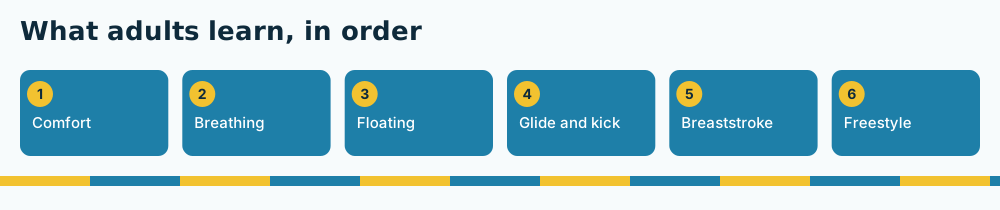
- Comfort and breathing. Face in the water, bubbles, rhythmic breathing.
- Floating and recovery. Front and back float, and standing up calmly from both.
- Glide and kick. Streamlined push-offs and an efficient kick from the hips.
- Breaststroke. Allows a breath every stroke and includes a clear glide phase.
- Freestyle. Side breathing, arm timing and staying relaxed.
- Deep-water skills. Treading water, changing direction and moving into deeper water.
There is no fixed timeline. Starting ability, confidence, attendance and practice all affect progress, and people who begin with fear may need more time on water comfort before working on strokes. Ask how progress will be reviewed instead of assuming a set number of weeks.
How your starting point is assessed
The first lesson is partly an assessment. The coach watches how you enter the water, whether you can put your face in and breathe out, whether you can float with or without support, and how calmly you stand up again. Adults who already swim a little are asked to swim a short distance so the coach can see body position, kick and breathing. The course then starts at the first stage you cannot yet do comfortably, rather than at stage one for everyone.
Progress milestones by stage
| Stage | What you practise | Ready to move on when you can |
|---|---|---|
| 1. Water confidence | Walking in chest-deep water, face in, blowing bubbles | Put your face in and breathe out slowly without panic |
| 2. Floating | Supported front and back float, then letting go | Float for a few seconds and stand up unaided |
| 3. Gliding | Push-off from the wall in a streamlined position | Glide a short distance with arms extended and legs together |
| 4. Kicking | Kickboard drills for flutter kick and breaststroke kick | Kick across the pool width with steady breathing |
| 5. Breaststroke | Arm pull, kick timing and breathing every stroke | Swim a short distance of breaststroke with regular breaths |
| 6. Freestyle | Side breathing, arm recovery and body roll | Swim a short distance of freestyle with side breathing |
| 7. Deeper water | Treading water, turning and moving away from the wall | Stay calm and in control in water where you cannot stand |
Deeper-water practice only happens with the coach beside you and within the pool operator’s rules.
Lesson format
Swim2u publishes 45-minute adult lessons in packages of 4, with 1-to-1, pair and group-of-3-or-more rates. Its directory lists public complexes and an island-wide condominium option, but that does not confirm a lesson at a particular pool. Ask which format, coach, permitted venue and timeslot are available before booking.
- 1-to-1: $320 for 4 lessons.
- Group of 2: $200 per person for 4 lessons.
- Group of 3 or more: $160 per person for 4 lessons.
Rates are from Swim2u's published price list (checked 3 November 2026); please confirm the current fee before paying. Public pool admission is charged separately by the pool operator, and condo lessons need the management’s permission for a visiting coach. More detail on the swimming course fees page. Women who prefer a female instructor can choose the ladies swimming course.
Factors to assess before setting an adult lesson plan
- Water comfort. Describe what happens when the learner enters, floats, submerges or moves into deeper water. A webpage cannot diagnose fear or assign the water-confidence programme; ask what can be assessed and confirmed.
- Attendance and practice. Ask what schedule is available and whether any between-lesson practice is appropriate for this learner and venue. This page does not prescribe a frequency, duration, depth or unsupervised drill.
- Movement and breathing. A coach may observe position, movement, coordination and breathing within the confirmed lesson scope, but those observations do not establish an ankle, fitness or medical diagnosis.
- Health and support information. Share relevant mobility, breathing, pain, medication or support needs, and seek medical advice where appropriate before agreeing activities or intensity.
For timeline limits, read how long it takes to learn swimming. If you already swim a little, our guides to breaststroke and bilateral breathing describe observation domains and safety limits rather than prescribing a lesson plan, and swimming and mental health separates exercise evidence from swimming-specific claims.
What a coach may observe
- Head and body position during a specified task.
- Breathing timing and whether symptoms require the activity to stop.
- Pace, rest and whether the agreed task remains controlled.
- How the learner responds to instructions, demonstrations and feedback.
These are observation areas, not universal mistakes or diagnoses. The cause, correction, safe practice and expected outcome must not be inferred from a webpage or one visible feature.
Private or group for adults?
Private and group formats have different published prices and attention structures, but neither is generally better for complete beginners, anxious learners, friends or partners. Confirm the course, learner compatibility, coach, venue, schedule and requested support before booking. See Swim2u’s adult lesson options and the private-versus-group comparison.
Sources
- CDC, Summer Swim Safety. Encourages adults to consider swim lessons to improve skills and comfort in the water, noting it is never too late to learn.
- American Red Cross, Adult Swimming Lessons. Adult learn-to-swim programme in which learners progress at their own pace, mastering one set of skills before the next.
Related guides
- Learning to swim as an adult: 5 mythsToo old, too heavy or too scared? What actually helps adults learn
- Freestyle and front crawl: components and limitsCompetition terminology, component references and assessment boundaries
- Swimming breathing: assessment and safety limitsObservation domains, symptom escalation and practice boundaries
- Lap swimmingWhat it is, why it works and how to start
- Swimming and mental healthExercise evidence, swimming-data limits and support routes
Browse all articles on the swimming blog.
Ask about adult swimming lessons
Share your current ability (for example: can't float, can swim a few metres, afraid of deep water) and the area you prefer. Ask which format and timeslot are currently available and suitable.